If you’ve ever been to our before while in laying season you’ve noticed our kitchen counter fills up with eggs. There are a lot of piles all over the place until they are each addressed, haha!
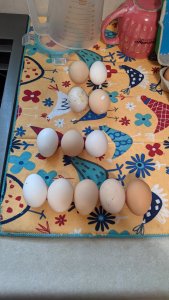
You might be thinking, well this is probably common since fresh eggs can be kept on the counter for extended periods of time. To be honest, yes that is a possibility but we get roughly six or seven fresh eggs every day for the two of us. That’s too many eggs!! We refrigerate ours after bringing them in to prolong their shelf life and keep them somewhere controlled while we give them out to our friends and family. Bringing in nearly 40 eggs a week adds up quickly and our small counters would be the dogs’ best friends via counter surfing.
So what is laying season?
Laying season is anywhere from early spring to mid or late fall when the gals are laying consistently. As the weather changes and the days become shorter, the hens lay less and less. Each breed requires a certain amount of consistent sunlight to produce eggs. On occasion you will see some chicken tenders run lights on a timer for their birds so they don’t have the typical season, which is okay! To each farmer their own! We prefer that winter break as we don’t have to worry about running out to the nesting boxes every hour in 0 degree weather to keep the eggs from freezing and “exploding”. There is also the opposite issue of when the weather is too hot or the weather changes are drastic. They slow down their laying to keep themselves healthy either by working their bodies to keep them warm or by saving energy to keep cool. Chickens and some ducks are hearty birds, meaning they can deal with very cold and hot temperatures. Of course, there are other measures we take to help keep them at the top of their game but we don’t use heat lamps in our coop.
In the time between being laid, being brought in the house, and then placed in the fridge there is a couple added steps.
Every day, it is noted (a) how many eggs there are from the day, (b) which egg came from which bird, and (c) any abnormalities. Keeping track of the number of eggs per day allows us to track how many we get each year and to keep an eye on our coop function. We keep tabs on which egg comes from each bird to make sure that nobody is sick, needing vitamins, or is being broody. It is generally easy to know which egg comes from which gal as they each have their own distinct features. When we have a set of newer layers it takes a couple days of watching, listening, and learning to figure out who laid which one. But it does get very easy after some time. We also track the abnormalities, such as a soft shell. extra calcium deposits, odd shapes, and weird sizes. This information also helps us to identify anything strange happening in the coop. If we are lucky, the newer layers might lay us a double yolk egg or an egg inside an egg!
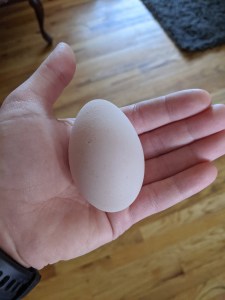
Here’s a couple strange eggs for you!

Now I bet you’re wondering if we do this every single day. Truth be told, nope no way, we ain’t got time for that! So what we do instead is keep them separated on the counter for a couple days, take some time one morning to enter them into a spreadsheet and then box them up in the fridge. We prefer to do this every couple of days to give us a significant number to work with instead of just a few everyday.
Our egg chores are my favorite and I will do them over laundry any day of the week!
I hope you learned something from why we track our eggs! If you have any questions, I’d love to hear them and work to answer them.
Take care, friends!

 Hallie Dantzler